While there are many reasons why you would want to consider sticking with Safari as your main browser, the fact remains that Google Chrome is still arguably the best browser. Not only has this likely been your default browser for years, containing all of your saved passwords, but Google has also added and supported some pretty useful features.
One such feature is the ability to essentially turn some of your favorite websites into full-blown apps with the click of a couple of buttons. Instead of using something like Fluid or Unite to turn a website into an application, you can just do so right from the Chrome browser.
How To Install Chrome Web Apps on Mac
This tool has become invaluable as Google opted to completely ditch the library of dedicated Chrome apps. Developers stopped really supporting those applications, leaving users with less-than-desirable experiences. But now, you can just install a Chrome Web App on your Mac, and use it just like you would any other app.
Open the Google Chrome app on your Mac.
Navigate to the website that you want to turn into an app.
In this example, we’re using the Todoist website.
Log into your account if necessary.
Once the webpage has loaded, click the three vertical dots in the top right.
From the drop-down menu, select Install [App].
Click the Install button to confirm.
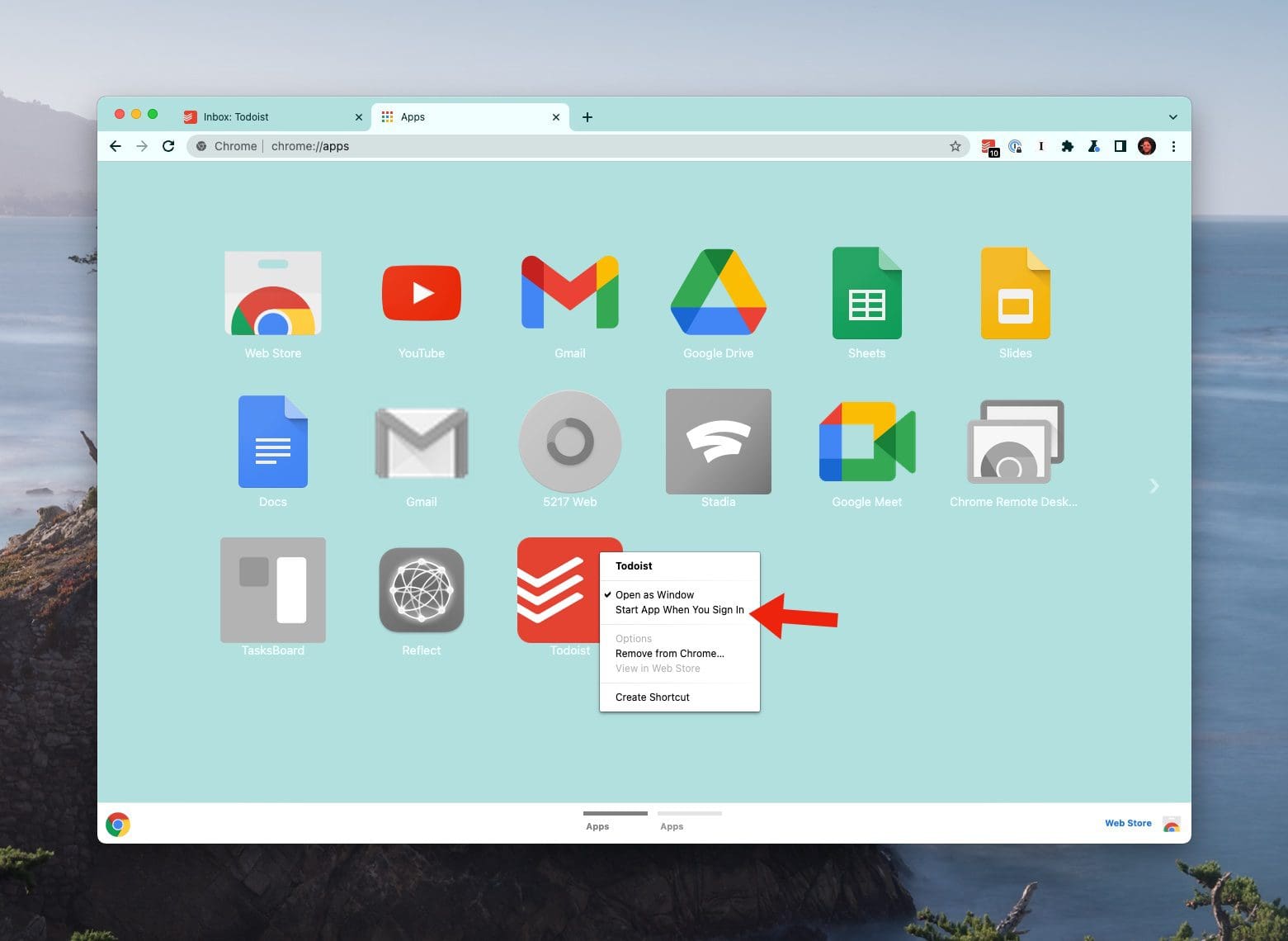
After the app has “installed”, you’ll be taken to the chrome://apps landing page, where you can view all of your other installed apps. If an app is installed, the icon will be colorful, matching the icon for the website or app that you are using. If an app is not currently installed or enabled, it will have a greyscale applied, signifying that it’s not installed or available.
Autorun Chrome Web Apps on Mac
While many of us don’t want a million apps opening every time our Macs are restarted, the fact remains that you will want to do so with certain apps. With the release of Chrome 91 on Mac, Windows, and Linux, you can now set these Chrome Web Apps to automatically launch as soon as you log in. Here’s how you can Autorun Chrome Web Apps on Mac:
Open the Google Chrome app on your Mac.
Navigate to chrome://apps using the address bar.
Locate the app that you want to autorun.
Right-click on the app icon.
Click Start App When You Sign In.
After selecting the right option, you won’t see any confirmation from Chrome. You can right-click the app icon again, just to make sure that the little checkmark appears next to Start App When You Sign In. In order to make sure everything is working properly, save what you’re doing in other tabs, and restart your computer.
After you log in, the Chrome app that you selected should launch along with any other apps. And if you change your mind and want to turn off this feature, just follow the same steps above to uncheck the option to start the app when you log in.
Andrew Myrick is a freelance writer based on the East Coast of the US. He enjoys everything to do with technology, including tablets, smartphones, and everything in between. Perhaps his favorite past-time is having a never-ending supply of different keyboards and gaming handhelds that end up collecting more dust than the consoles that are being emulated.












Write a Comment